
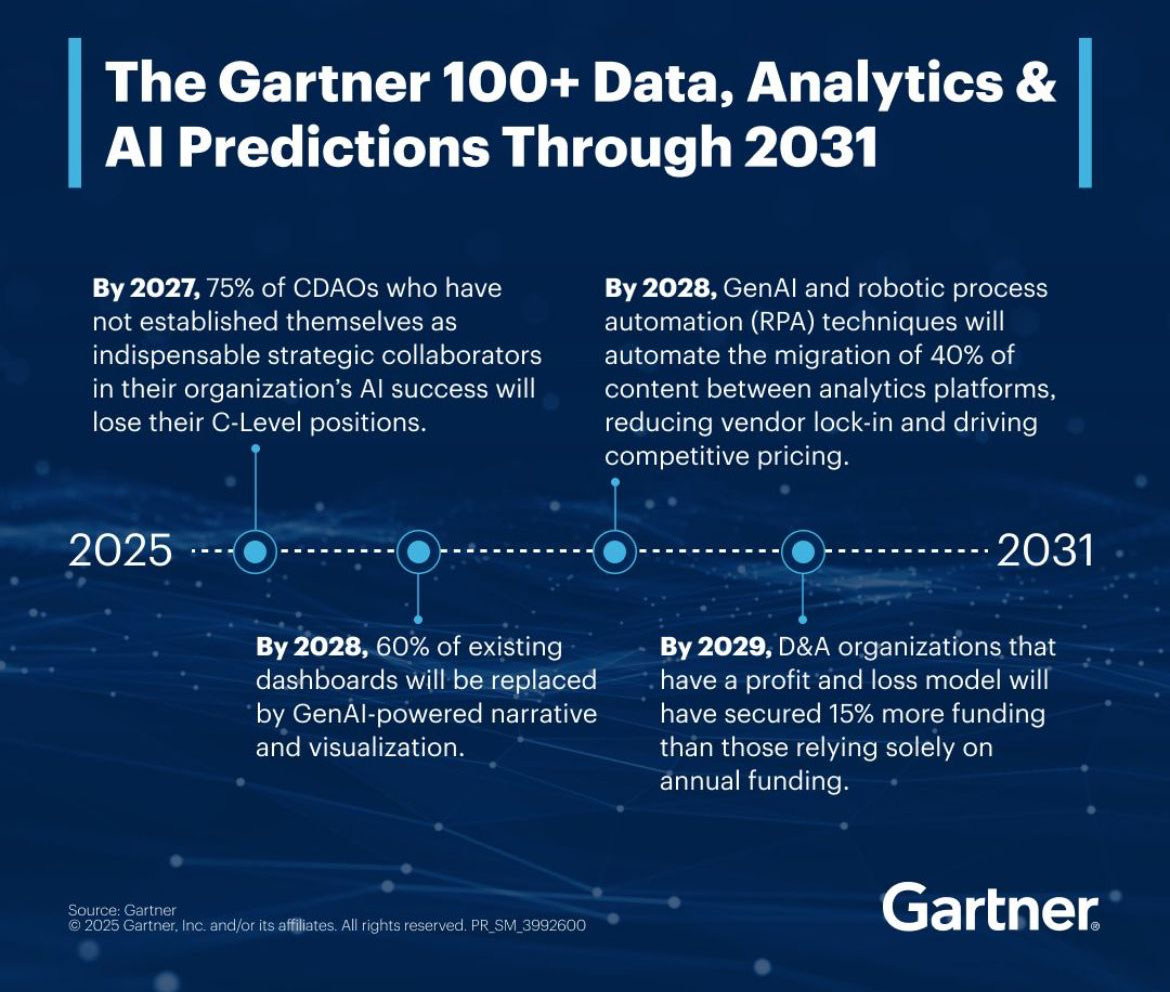
Generative AI turns analytics from reporting into decision support: instead of reading a dashboard, you ask the system a direct question and get an understandable answer with its reasoning. At its Data & Analytics Summit in Sydney in July 2024, Gartner put forward the assumption that by 2028, 60 percent of current dashboards will be replaced by narratives and visualizations produced by generative AI. This is a Gartner Strategic Planning Assumption rather than a measured observation, so it is worth reading as an indication of direction, not as a promise about timing.
For a growth company this doesn't mean buying a new BI platform. It means getting existing data, which is often scattered across CRM, ERP, and spreadsheets, to answer business questions without a separate data analyst.
Generative AI analytics in brief
- Definition:
- Generative AI analytics means bringing large language models into the data pipeline, so business users query data in natural language and get plain-language answers instead of static dashboards.
- Key difference from traditional BI:
- A dashboard tells you what happened; generative AI tells you why it happened and what to do next.
- What adoption requires:
- Connected data infrastructure, a language model with context management, an analytics engine, and security and governance.
- Where to start:
- From an assessment of existing data and processes, not from choosing a tool.
What Is Generative AI Analytics and How Does It Work?
Generative AI analytics brings large language models (LLMs) into the entire data pipeline and turns data utilization from reporting into decision support. Instead of business users spending time browsing reports or building technical queries, they can ask the system direct questions and receive immediately understandable answers.
Traditional analytics describes the past or predicts the future. Generative AI goes further: it creates new content based on data. In practice, this means that when a user asks a question in natural language (for example, "Why did sales drop in May?"), the system formulates the necessary query, retrieves the right data, processes it, and produces a clear summary, recommendation, or visualization of the results.
This opens up data analysis in two ways. First, it brings deep analysis to users without a technical background. Second, it lightens the workload of data professionals by automating time-consuming routines such as data cleaning, query writing, and drafting recurring reports. Decision-making speeds up and analytics use spreads across the whole organization.
Why Aren't Traditional Dashboards Enough Anymore?
A traditional dashboard tells you what happened, but not why it happened or what to do next. For steering growth it is too slow and too dependent on the interpreter. The same limitation shows up on the sales side too, as we covered in why CRM data alone isn't enough for revenue teams.
Static information in a dynamic world
Traditional dashboards are snapshots of the past, like photographs of business history. For example, a sales director might see on a dashboard that sales have dropped 15 percent in a certain region. The number alone doesn't reveal whether the decline is due to a competitor, delivery problems, price changes, or customer behavior. The dashboard answers "what happened", but leaves the user to ponder "why" and "what next".
Interpretation is left to a few
Traditional analytics often requires the ability to read complex tables, build queries, and interpret data in a broader context. This creates a situation where data is abundant, but only a few know how to use it. A large portion of staff make decisions without easy access to understandable information, not because data doesn't exist, but because its interpretation is perceived as difficult.
Time lag from insight to action
In traditional processes, insight and decision are often too far apart. If an analyst must first assemble a report, check data quality, produce visualizations, and present findings to management, days or even weeks may pass before actions begin. In fast-paced business, this delay leads to lost sales opportunities and rising costs.
How Does Generative AI Fix These Problems?
Generative AI produces a plain-language explanation and a recommendation from the data, not just a number. The difference from a traditional dashboard is concrete:
| Aspect | Traditional BI | GenAI analytics |
|---|---|---|
| What does the user get? | A number or a chart | An explanation, the causes, and a recommendation |
| Who can access data? | Analysts and technical users | Anyone, in natural language |
| Time from question to answer | Hours or days | Minutes |
| Direction | Describes the past | Anticipates and suggests actions |
1. Contextual, plain-language explanations
GenAI analytics automatically produces narratives that explain the meaning of data.
Traditional dashboard: "Regional sales: -15%"
GenAI narrative: "Region B sales have dropped 15% over the last month. The decline is primarily due to a competitor's new product launch and the expiration of contract periods with three key customers. Recommendation: activate the customer retention program and offer these customers a renewal over the next two weeks."
2. Predictive and proactive analytics
Generative AI doesn't just report the past, but anticipates future trends and suggests actions. It identifies anomalies in real time and provides automatic alerts.
3. Data analytics for everyone
Natural language queries make analytics accessible to everyone. A sales director can ask: "Why were Q3 targets not met in Northern Europe?" and immediately receive a thorough analysis, without SQL queries or a data analyst's help.
4. Dynamic, customized visualizations
Generative AI automatically creates visualizations that match each user's needs and questions. The same data can be presented to a CFO as a financial trend analysis and to a product manager as a user experience map.
Examples of use cases across industries
Retail: Inventory optimization
Generative AI can be leveraged in inventory management by combining sales history, external forecasts (such as weather and events), and current trends. The system produces plain-language, predictive recommendations for business users to improve product availability.
Benefits:
- Better demand forecasting
- Faster response to changes
- Less waste and more efficient capital use
Finance and insurance: Risk management
Generative AI supports risk management by forming risk profiles from multiple data sources. Instead of decisions being based on individual metrics, the system explains risk changes and their underlying factors in an understandable way.
Benefits:
- Better risk anticipation
- More transparent and justified decisions
- Better balance between risk and return
Healthcare and public services: Resource optimization
Generative AI can be used for demand forecasting and resource allocation in environments where load varies rapidly. The system predicts future demand and suggests concrete actions for personnel and capacity management.
Benefits:
- Shorter waiting and throughput times
- Better service quality and customer experience
- More efficient resource use and cost management
Manufacturing: Predictive maintenance
In industrial environments, generative AI can be used to analyze equipment and sensor data. This allows identification of anomalies and anticipation of failures. The system not only alerts to risks but recommends maintenance actions from a business perspective.
Benefits:
- Fewer unplanned production interruptions
- Lower maintenance and downtime costs
- Better overall production efficiency
What Does Implementing GenAI Analytics Require in Practice?
Adding generative AI to analytics is not a single plug-in, but it rests on a few building blocks. For a growth company the key insight is that the biggest job is not the language model, but the data and integrations underneath it.
In practice, four parts are needed:
- Data infrastructure: data from different sources has to be brought together and kept current enough. This is most often where a growth company gets stuck, because the data is scattered across systems.
- Language model and context management: the model must understand the company's industry, terminology, and key metrics, so the answers are correct and not just plausible-sounding.
- Analytics engine: the actual data processing and statistical analysis are done by an analytics engine, for which the language model acts as the interface and interpreter.
- Security and governance: the system must comply with data access rights, protect sensitive information, and produce traceable, auditable results.
This is exactly why it pays to start from an assessment of existing data and processes, not from choosing a tool. Once you know which data is scattered and which questions you want answered, you also know which integrations the implementation requires.
Implementation Challenges and How They Get Solved
Challenge 1: Data quality and consistency
Generative AI is only as good as the data it operates on. Broken or inconsistent data leads to misleading findings.
How it gets solved: start with data governance that standardizes data collection, storage, and quality control. You can assess an organization's readiness for this in 5 signs your company is ready for data-driven decisions.
Challenge 2: User trust and adoption
People are reasonably skeptical of "black box" recommendations, especially in critical decisions.
How it gets solved: choose a system that justifies its conclusions and shows what data they are based on. Start with a pilot on a low-risk use case and build trust gradually.
Challenge 3: Integration with legacy systems
Many organizations use years-old ERP and CRM systems, whose integration with a modern GenAI environment is laborious.
How it gets solved: leverage API-based integrations and proceed in stages, adding AI first where the benefit is clearest and expanding from there.
Challenge 4: Costs and payback
The technology can be expensive, and demonstrating return on investment up front is hard.
How it gets solved: start with a defined use case that has measurable metrics. Calculate payback both as direct savings (for example, reduced analyst hours) and indirect benefits (faster decisions, better customer experience).
The Future of Generative AI Analytics
Multimodal analytics
Next-generation systems will simultaneously analyze structured data, text, images, and video. For example, in retail, the system could combine sales figures with customer behavior interpreted from in-store video footage in the same analysis.
Autonomous decisions
Generative AI is gradually moving from recommending to autonomous decision-making in low-risk situations. For example, in inventory management, the system won't just suggest but will automatically place orders with suppliers within defined rules. We cover this boundary between suggestion and autonomous action in what are autonomous AI agents.
Collaborative analytics
Future tools will work with multiple decision-makers and combine different perspectives. The system could, for example, provide data-driven perspectives to each participant's questions in real time during a strategy meeting.
Summary: Where to Start
Generative AI turns analytics from numbers into explanations and recommendations, and opens data to those without a technical background too. Gartner's assumption about dashboards being replaced by 2028 indicates the direction the field is expected to take. A forecast is not evidence, but it does set the timeframe within which the question is worth addressing.
For a growth company the benefit doesn't come from acquiring yet another tool, but from getting scattered data to answer the right questions. In practice, the path runs the same way as in other operational AI projects: the assessment shows what the data can reveal and which integrations are missing, implementation builds a working whole, and continuous development keeps it up to date.
FAQ: Generative AI Analytics
What is generative AI analytics? Generative AI analytics refers to the integration of large language models (LLMs) and generative artificial intelligence into data analytics pipelines. It allows business users to query data in natural language, automatically translates those queries into database code (like SQL), executes the analysis, and generates plain-language summaries and dynamic visualizations instead of static dashboard reports.
How does generative AI analytics differ from traditional BI dashboards? Traditional Business Intelligence (BI) dashboards display static past performance data, answering "what happened." Generative AI analytics goes beyond by answering "why it happened" and "what to do next," automatically offering narrative context, detecting anomalies, and providing proactive recommendations.
Is data secure when using generative AI analytics? Yes, when properly implemented with enterprise-grade models. Secure generative AI analytics keeps your data isolated, complies with company access permissions, prevents data from being used to train public language models, and ensures all AI-generated insights are traceable back to verified data sources.
Want to know what generative AI could automate in your business?
The Automation Assessment identifies where generative AI speeds up data interpretation and reporting in your processes, and how much it saves.
Book an Automation AssessmentEmpirica Finland helps growth companies build AI solutions and automations that create true operational visibility and efficiency.
Sources
What are the claims in this article based on?
- Gartner Data & Analytics Summit 2024 Sydney: Day 2 Highlights
Gartner, published 30 July 2024
The source for the dashboard prediction in this article. A Gartner Strategic Planning Assumption is a forecast rather than a measured observation, and it was presented in a conference session in July 2024.
These sources were last checked on 3 September 2026.