CASE: Metsä Board
Real-Time Transport Monitoring
Real-time transport monitoring tracks transport conditions and shipment location. Data and analytics from monitoring sensors help reduce waste. Reduced waste lowers costs and improves customer satisfaction.
Metsä Board
Real-Time Transport Monitoring
Real-time transport monitoring tracks transport conditions and shipment location. Data and analytics from monitoring sensors help reduce waste. Reduced waste lowers costs and improves customer satisfaction.
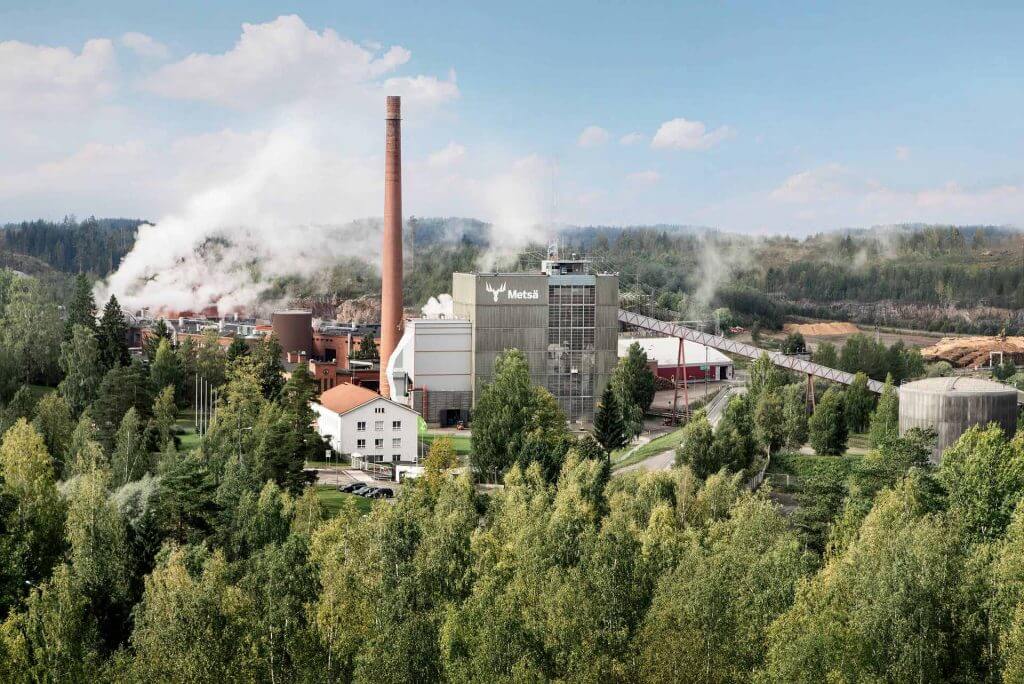
Metsä Board is a Finnish publicly listed company and a leading manufacturer of high-quality virgin fiber paperboards. The main applications for Metsä Board's products are consumer product packaging for food, cosmetics, pharmaceuticals and electronics, as well as retail display stands and shelf-ready packaging. The company actively works on developing new, more environmentally friendly packaging solutions and is a sustainability leader in its industry. Metsä Board's customers include branded product manufacturers, converters and distributors. Products are delivered to approximately one hundred different countries.
Why is an outsourced transport supply chain hard to monitor?
In outsourced transportation, the customer's visibility is limited to node points such as shipment arrivals at terminals, and no information is obtained about events during transit. Shipments pass through several different operators, delivery times in global transportation are long, and there are multiple intermediate storage points along the way. When only the information provided by transportation and warehousing companies is available, bottlenecks and problem areas cannot be identified.
Metsä Board delivers its products to approximately one hundred countries, so supply chain efficiency is a fundamental prerequisite for profitable business. With proprietary tracking, data can be collected from shipments and used to optimize the supply chain and find problem areas. Good visibility matters both for estimating delivery times and for monitoring transport conditions.
What does transport damage actually cost?
Transport damage costs considerably more than the value of the spoiled product. A shipment arriving damaged delays deliveries, causes extra manual work for both the customer and the supplier, and degrades the customer experience, so the cost accumulates from three directions at once.
Although paperboard generally withstands long transportation and varying conditions well, excessively high humidity can cause the product to become wet. For this reason, it is important that the plastics protecting the packages remain intact throughout the entire transportation. Deliveries arriving on time and in good condition are a direct precondition for customer satisfaction.
How are shipments tracked in real time?
Reusable sensors were attached to the shipments, measuring location and transport conditions across the whole journey from the production facility to the customer. Intel's logistics sensors with replaceable batteries were selected, because they withstand temperatures of 50 degrees for extended periods, dust and high humidity, and their battery life is approximately 200 days.
The requirements came directly from the operating environment: challenging transport conditions, long transport times and the shipment handling process meant the sensors had to tolerate both temperature and humidity and to run for a long time on one battery.
Once the functionality of the sensors was verified, the sheet pallets were ready to travel. The sensors were attached to the sheet pallets, and conditions during transportation could immediately be monitored in real time. With the data, a good understanding of transportation routes, schedules, and conditions was quickly obtained. The data showed, among other things, the exact location of shipments with timestamps, intermediate storage times and locations, as well as changes in conditions during transport.
How is the cause of package damage located in the data?
The system was taught to recognize the parameters that change when the protective plastic breaks. When the transport conditions measured by the sensors were combined with the damage records made at storage points, the time and location of the breakage could be determined accurately. The problem was pinpointed to a specific point on the route, so it can be prevented in advance in future.
The groundwork was done along the route: the condition of packages was checked at storage points, damaged packages were repaired, and the damage was recorded in the system. Even this data, together with the sensor data, helped narrow down the possible causes, and a more detailed analysis validated the result. Waste was reduced and the project's benefits were realized quickly.
What does AI add to freight data analysis?
AI automates and accelerates the data analysis process, which reduces the amount of manual work and keeps analysis costs low. The largest gain comes from the labor-intensive data preparation phase, where raw data is transformed into a dataset: that is precisely where automation significantly reduces the workload required for analysis.
In addition, with the help of AI, observations were made from the data that would have easily gone unnoticed by the human eye. In real-time monitoring, sensors send values of various measurements at short intervals, and due to the large amount of data, momentary deviations easily remain hidden in simple visualization. AI is excellent for finding insights and patterns in large amounts of data. Based on patterns identified in the data, predictions can be made, future problems can be anticipated, and proactive action can be taken to eliminate problems. Proactivity promotes supply chain efficiency and reduces waste.
What did real-time tracking achieve?
With the help of Empirica's real-time shipment tracking and freight data analysis, package breakage locations were successfully pinpointed accurately, and problems could be addressed immediately. The entire tracking system is powered by a scalable and secure cloud infrastructure that enables real-time processing of massive amounts of data. Learn more about our Azure solutions.
"The collaboration with Empirica worked well, and we were able to clarify the stages of the route."
Leena Yliniemi
Product management director, Metsä Board
Other customer stories

Is your situation similar?
Tell us what work repeats in your company and what data your systems or devices already produce. In 30 minutes we will go through whether something similar could work for you. The first conversation is free.
Arrange a 30-minute callRead about the automation assessment